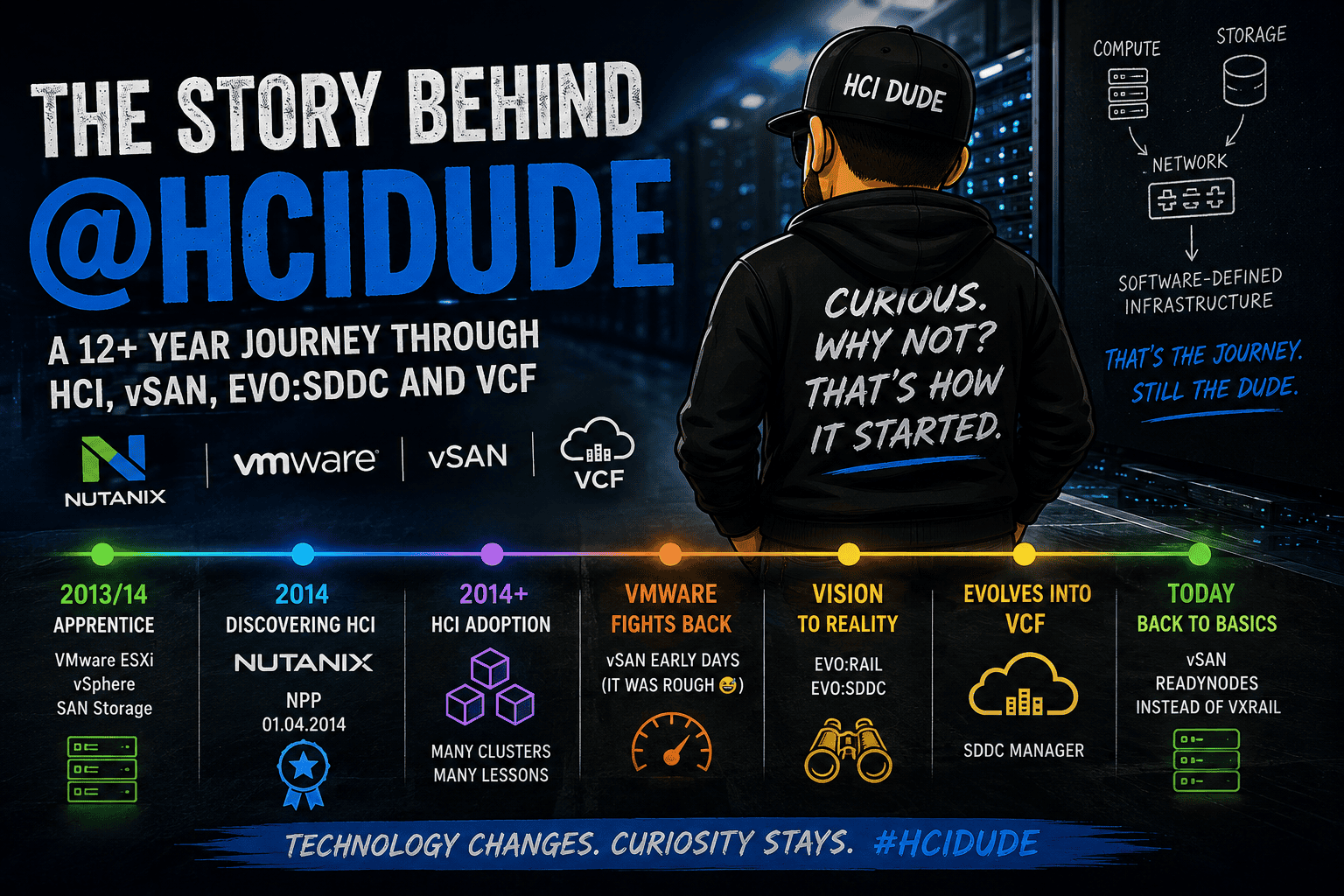
From an IT apprentice to HCI Dude – a 12+ year journey through Nutanix, vSAN, EVO:SDDC and VCF
People sometimes ask me where @hcidude comes from.
The short answer is:
I didn’t really choose it. It kind of happened.
And looking back more than twelve years later, the story behind the name is actually a pretty good reflection of my career in infrastructure.
Where it all started
The story starts in late 2013 or early 2014.
I was in the final stretch of my apprenticeship as an IT-Systemkaufmann (IHK), a sales-oriented IT education combining technology, business and sales.
But I already knew where I wanted to go.
I wanted to become a System Engineer, working with x86-based virtualization.
At that time, my world was pretty straightforward:
VMware ESXi.
vSphere.
SAN Storage.
The classic virtualized infrastructure stack.
Compute was here.
The hypervisor was here.
Storage was over there.
And the SAN connected everything together.
That was the infrastructure world I knew.
“You should watch this.”
Then the Head of our Cloud Competence Center showed me a YouTube video.
It was called:
“Simple Explanation of How Nutanix Works.”
And this was the video that started it all.
I had already heard about Nutanix, but I didn’t really know what to make of it.
And suddenly, there was a completely different way of thinking about infrastructure.
Instead of relying on a traditional external SAN, Nutanix used the local storage inside the x86 nodes.
But the important part wasn’t simply using local disks.
Nutanix put the storage controller logic into a dedicated Controller VM, or CVM, running on each node.
The CVMs worked together across the cluster and provided the distributed storage layer for the virtual machines.
For someone coming from VMware ESXi, vSphere and SAN Storage, this was fascinating.
It was a completely different way of thinking about where infrastructure functionality should live.
And I wanted to know more.
“It’s a waste of time.”
Not everybody around me was convinced.
Some of my older colleagues thought it was interesting.
Others thought it was a waste of time.
And honestly, I understood why.
The traditional infrastructure model was established.
SANs worked.
VMware worked.
There was a huge ecosystem around it.
Why should this new thing suddenly replace all of that?
But I had one major advantage:
I had nothing to lose.
I was still an apprentice.
I wasn’t replacing a technology I had spent ten years mastering.
I wasn’t risking an established career.
I could simply learn something new.
So I thought:
Why not?
That one decision would change the direction of my career.
April 1, 2014
My curiosity turned into something real.
I got the opportunity to attend Nutanix training with Baas Rayman.
And on April 1, 2014, I successfully passed my NPP – Nutanix Platform Professional certification.
April 1.
Looking back, that date almost sounds like a joke.
But it wasn’t.
It was the beginning of a journey that would shape a huge part of my professional life.
At that time, Nutanix had only three employees in Germany.
Three.
And then things started moving incredibly fast.
Nutanix grew rapidly in Germany.
More customers.
More employees.
More projects.
More clusters.
And I was lucky enough to be right in the middle of it.
I wasn’t just reading about HCI.
I was installing it.
Again.
And again.
And again.
At one point, I even held what was, as far as we knew, the unofficial record for the most installed Nutanix clusters in Germany.
I never set out to achieve that.
It simply happened because I was curious, kept saying yes to opportunities and genuinely enjoyed working with this new technology.
When HCI became my nickname
And somewhere along the way, something funny happened.
People started associating me with Hyper-Converged Infrastructure.
It became something like:
“Hey, you’re the guy who does Hyper-Converged Infrastructure, right?”
And somehow that became:
HCI Dude.
And eventually:
@hcidude
I didn’t sit down one day and invent a brand.
The name came from what I was actually doing.
It was almost a nickname.
And it stuck.
Then VMware started fighting back
The story could have ended there.
It didn’t.
Over the following years, VMware became more and more of a real competitor to Nutanix in the HCI space.
And I had a front-row seat to that evolution.
The early days of VMware Virtual SAN, or vSAN, were rough.
Let’s just say the early vSAN experience wasn’t exactly what I would call a masterpiece. 😅
VMware was clearly working on a different way of approaching storage inside the virtualization stack.
The company had acquired Virsto in 2013 as part of its broader storage technology strategy, and over time VMware continued to push more infrastructure functionality into software.
Then came vSphere 6 and the evolution of vSAN.
And things started getting serious.
VMware wasn’t simply adding another storage feature to vSphere.
It was moving towards something much bigger.
From HCI to the SDDC
The vision became:
Compute + Storage + Network + Management + Automation
Everything becoming increasingly software-defined.
The Software-Defined Data Center.
And then came EVO:RAIL.
This was another big step.
Instead of giving customers a collection of individual infrastructure components and asking them to put everything together themselves, VMware started moving towards an integrated, standardized infrastructure experience.
Then came EVO:SDDC.
At the time, EVO:SDDC felt like a vision of where the entire infrastructure stack could go.
Looking back today, the evolution is fascinating.
What was once called EVO:SDDC has evolved into the world we know today as VMware Cloud Foundation.
The SDDC Manager became a central part of that operational model.
What started as a vision became a platform we actually deploy and operate.
We used both
One of the things I find particularly interesting when looking back is that this wasn’t simply a story of “Nutanix versus VMware”.
We actually used both.
We deployed Nutanix.
We also used VMware-based HCI platforms such as EVO:RAIL and later VxRail.
Different platforms.
Different approaches.
Different ecosystems.
But all of them were part of the same broader transformation.
The infrastructure stack was moving away from the traditional model of separate servers, SANs and appliances towards software-defined, highly integrated infrastructure running on x86 hardware.
And I was lucky enough to experience that evolution from the beginning.
From VxRail to ReadyNodes
And now there is another interesting twist.
We used VxRail alongside Nutanix.
Today, our direction is increasingly based on vSAN ReadyNodes instead.
VxRail is slowly becoming less central to our approach, while the value increasingly sits in the software platform itself.
And once again, the infrastructure underneath the platform becomes almost secondary.
The hardware provides the foundation.
The software provides the intelligence.
The platform provides the experience.
Sound familiar?
It should.
Because that was exactly what fascinated me about HCI back in 2014.
More than a username
That’s why I still like @hcidude.
The technology behind the name has changed dramatically.
In 2014, it was Nutanix.
Then came the rise of VMware vSAN.
EVO:RAIL.
EVO:SDDC.
VxRail.
SDDC Manager.
VMware Cloud Foundation.
VCF.
And today, vSAN ReadyNodes.
The acronyms changed.
The products changed.
The vendors changed.
My role changed.
My career changed.
But the name stayed.
Because @hcidude isn’t really about one product.
It isn’t even really about HCI anymore.
It represents something that started back when I was still an apprentice:
Curiosity.
I saw something new.
People around me weren’t convinced.
I had nothing to lose.
So I asked:
“Why not?”
That question led to a Nutanix certification on April 1, 2014.
It led to countless cluster installations.
It led to working with some incredible people.
It led me through the evolution of HCI, vSAN and the SDDC.
And it ultimately became part of my professional identity.
I didn’t really choose the name.
It was earned along the way.
More than twelve years later, the technology has changed almost beyond recognition.
But apparently…
I’m still the dude. 😎
The journey in one line
Apprentice → VMware + SAN → Nutanix → NPP → HCI → countless clusters → vSAN → EVO:RAIL → EVO:SDDC → VCF → vSAN ReadyNodes → @hcidude
And it all started with a simple question:
Why not?




Schreibe einen Kommentar