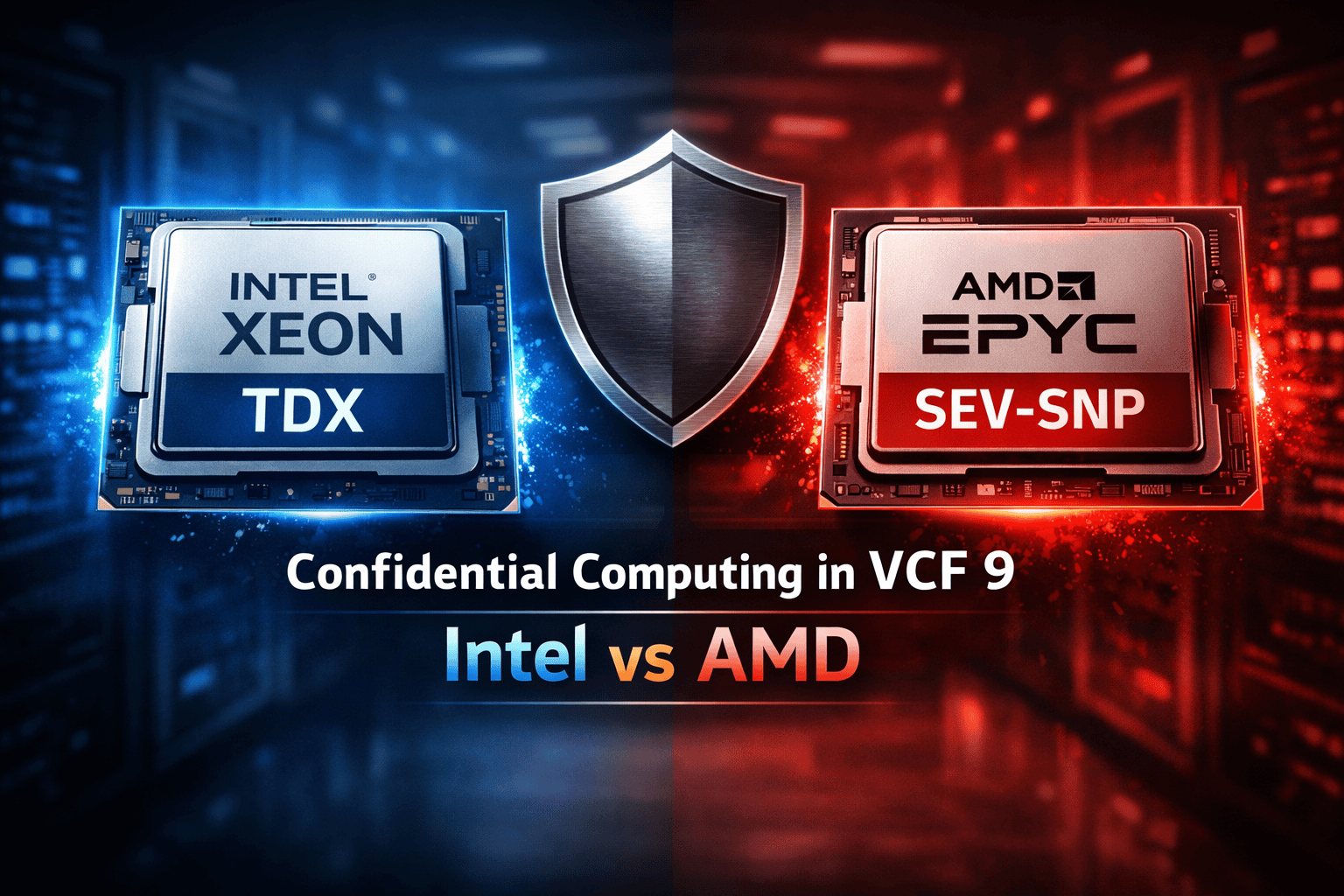
The Complete Confidential Computing Comparison for Private Cloud Architects
Confidential Computing is no longer a hyperscaler-only topic. With VMware Cloud Foundation 9, Confidential Virtual Machines are officially supported on both Intel and AMD platforms.
After deploying Intel TDX in VCF 9, the next logical question is:
What about AMD?
The answer is AMD SEV-SNP
This article provides a deep technical comparison between:
- Intel TDX
- AMD SEV-SNP
- Operational impact inside VCF 9
- Performance considerations
- Architectural trade-offs
Why Confidential Computing Changes Private Cloud Design
Historically, virtualization assumed a trusted hypervisor.
Confidential Computing breaks that assumption.
The threat model now includes:
- Malicious or compromised hypervisor
- Host-level memory inspection
- Privileged infrastructure access
In VCF 9, trust shifts from infrastructure to hardware-backed cryptographic isolation.
Intel TDX Architecture
Intel TDX – Trust Domain Extensions – introduces a new execution environment inside the CPU.
Core design elements:
- Trust Domains (TD) replace traditional VMs
- Multi-Key Total Memory Encryption (MKTME)
- TDX Module running in SEAM mode
- Page metadata validation via PAMT
- Explicit hypervisor communication through TDCALL
TDX creates a hardware-enforced isolation boundary that even the hypervisor cannot cross.
This is a new execution model – not an extension of existing virtualization.
AMD SEV-SNP Architecture
AMD SEV-SNP – Secure Encrypted Virtualization with Secure Nested Paging – enhances AMD’s Secure Virtual Machine (SVM) model.
Key components:
- Per-VM encryption keys
- Hardware-managed Reverse Map Table (RMP)
- Memory page validation
- Integrity protection against remapping attacks
- Attestation via AMD Secure Processor
Unlike TDX, SEV-SNP extends the virtualization stack rather than creating a new execution mode.
The result: similar protection goals, different architectural philosophy.
Direct Comparison
| Feature | Intel TDX | AMD SEV-SNP |
|---|---|---|
| Isolation Construct | Trust Domain | Confidential VM |
| Execution Model | New SEAM mode | Extended SVM |
| Memory Integrity | PAMT validation | RMP validation |
| Encryption Keys | Managed by TDX module | Managed by Secure Processor |
| Attestation | Intel Trust Authority | AMD KDS / VCEK |
| Hypervisor Interface | TDCALL | VMGEXIT |
Both protect against:
- Hypervisor memory reads
- Page table tampering
- Unauthorized memory remapping
But TDX isolates by creating a new domain.
SEV-SNP isolates by enforcing memory integrity rules.
Confidential VMs in VMware Cloud Foundation 9
Inside VMware vSphere within VCF 9:
- VM Hardware Version 22+ required
- Full memory reservation mandatory
- No classic vMotion
- Snapshot limitations
- Reduced introspection capability
This fundamentally changes operational design.
Confidential VMs prioritize workload isolation over cluster mobility.
Attestation – The Real Security Shift
Both technologies rely on hardware-backed attestation.
Intel TDX:
- Quote generated inside TDX module
- Verified via Intel trust services
AMD SEV-SNP:
- Report generated by Secure Processor
- Signed using VCEK
- Verified via AMD Key Distribution Service
Attestation enables:
- Secret injection workflows
- Zero Trust workload startup
- Measured boot enforcement
Trust is no longer assumed.
Trust is verified.
Performance and Operational Impact
Enabling Confidential VMs introduces trade-offs:
- Higher VMEXIT cost
- Memory encryption overhead
- No memory overcommit
- Stricter NUMA alignment
- Reduced DRS flexibility
This is not designed for maximum consolidation ratios.
It is designed for high-assurance workloads.
When to Choose Intel TDX
TDX may be ideal if:
- Your roadmap includes Sapphire Rapids or newer Xeon CPUs
- You prefer domain-based isolation
- Intel attestation ecosystem aligns with compliance needs
When to Choose AMD SEV-SNP
SEV-SNP is compelling if:
- EPYC platforms are already standard
- High core density per host is important
- You prefer virtualization extensions over new execution modes
- Independence from Intel attestation services is required
Strategic Perspective
Confidential Computing in VMware Cloud Foundation 9 is not about feature parity.
It is about:
- Sovereign cloud readiness
- DORA and NIS2 compliance
- AI workload isolation
- Multi-tenant security boundaries
Intel TDX and AMD SEV-SNP both deliver workload isolation from the hypervisor.
But they represent two different architectural philosophies.
And that decision belongs in your hardware and compliance strategy – not in a checkbox comparison.
Final Verdict
There is no universal winner.
There is only architectural alignment.
Confidential Computing is redefining private cloud trust models.
The question is not: “Which is better?”
The real question is: “Which trust boundary fits your VCF design?”

Schreibe einen Kommentar