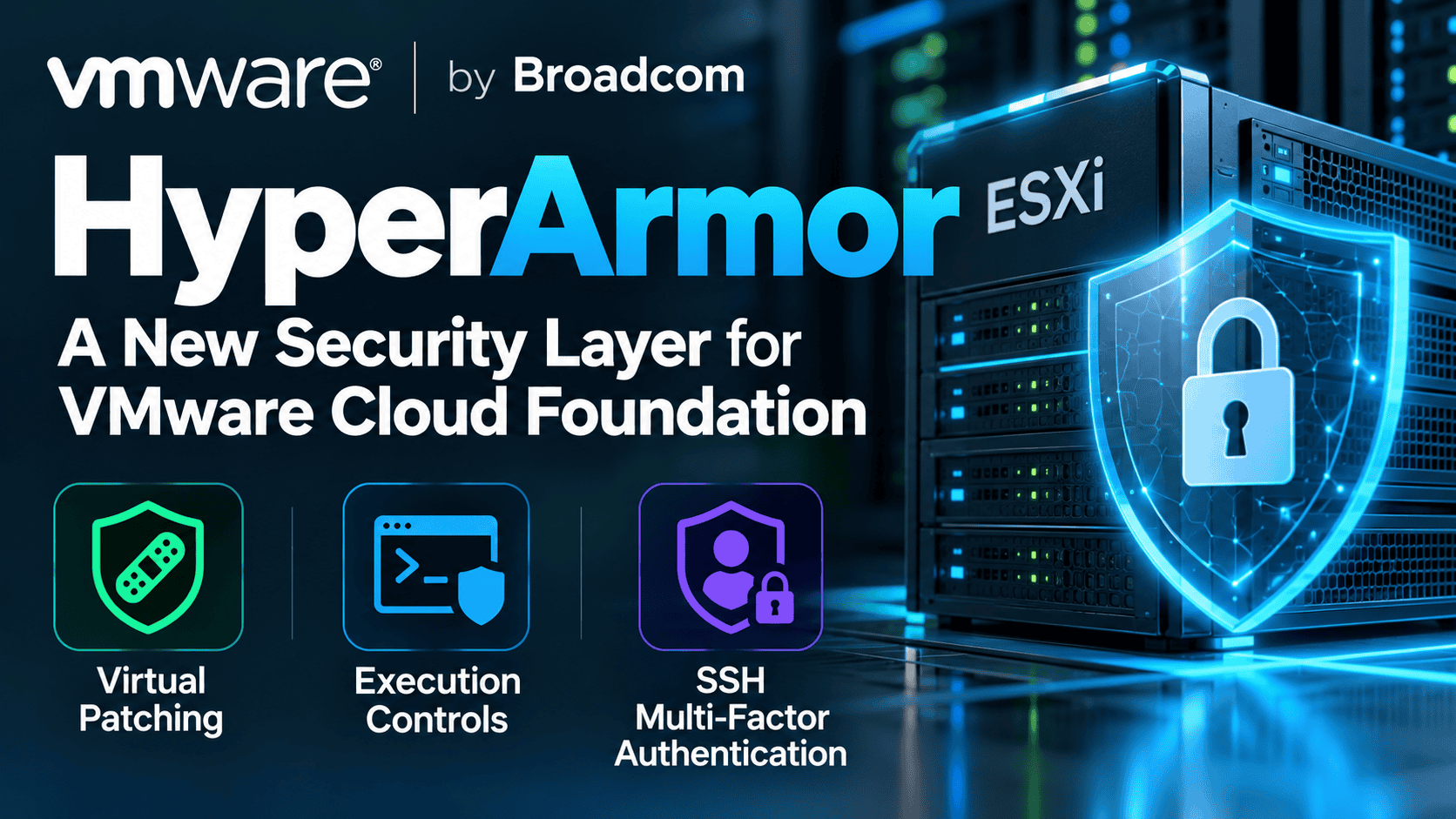
Broadcom has introduced VMware HyperArmor, a new security solution designed to strengthen the security of the ESX hypervisor in VMware Cloud Foundation (VCF) environments. Announced on October 13, 2026, HyperArmor focuses on three important areas: virtual patching at the hypervisor layer, host execution controls and multi-factor authentication for ESXi SSH access.
The announcement addresses a fundamental challenge in infrastructure security: how do you protect the hypervisor against vulnerabilities and compromised credentials without unnecessarily disrupting production workloads?
In this article, we will look at what VMware HyperArmor brings to the table, how it complements existing VCF security capabilities and what infrastructure architects and administrators should consider.
Read the official Broadcom announcement.
Why Hypervisor Security Matters
The hypervisor is one of the most critical components in a virtualized infrastructure. It provides the execution environment for virtual machines and sits between workloads and the underlying physical hardware.
A compromise at this layer can have consequences far beyond a single application. Depending on the attack and the privileges obtained, an attacker could potentially affect multiple workloads, access sensitive data or disrupt entire infrastructure services.
Two particularly relevant attack vectors are:
- Compromised administrative credentials: Stolen root credentials can provide direct access to ESXi management interfaces and command-line operations.
- Unpatched vulnerabilities: Even well-managed environments have exposure windows between the disclosure of a vulnerability and the deployment of an applicable security update.
Traditional security measures remain essential, but they do not eliminate these risks entirely. Patching requires testing and coordination, while credential protection depends on multiple controls working together.
HyperArmor aims to add preventive controls directly at the hypervisor layer, reducing exposure while allowing organizations to maintain their existing operational processes.
What Is VMware HyperArmor?
VMware HyperArmor is a security solution for the ESX component of VMware Cloud Foundation. Broadcom announced support for VMware ESX 8.x and later releases.
The solution introduces three principal capabilities.
1. Hypervisor-Level Virtual Patching
One of the most significant features is virtual patching at the ESX host layer.
According to Broadcom, HyperArmor can detect and block attempted malicious actions on the host before an underlying vulnerability can be exploited. This protection is intended to reduce exposure without requiring an immediate ESXi software upgrade or host reboot.
Why does this matter?
Consider a newly disclosed vulnerability affecting the hypervisor. A production environment might require several steps before the official remediation can be deployed:
- Assess the vulnerability and determine which systems are affected.
- Validate the vendor-provided fix in a test environment.
- Schedule maintenance activities and coordinate with application owners.
- Deploy the update and verify that the environment remains healthy.
During this process, vulnerable systems may remain exposed.
Virtual patching introduces an additional protective measure while administrators prepare and validate the official remediation.
Important distinction: Virtual patching is not a replacement for security updates. It reduces exposure while the organization works toward a supported, permanent fix. Administrators must continue to follow VMware security advisories and applicable patching guidance.
2. Positive Host Security Guardrails
HyperArmor also introduces execution controls designed to prevent unauthorized executables and scripts from running on an ESX host.
The concept is based on a positive security model: rather than assuming that every executable is acceptable unless explicitly blocked, the system establishes a baseline of known-good activity.
According to Broadcom, HyperArmor inventories existing scripts on the host and permits them automatically. Administrators can approve additional scripts when required. Unauthorized executables and scripts are then blocked.
This is particularly relevant because ESXi is a specialized operating system with a comparatively narrow set of expected processes and administrative operations.
A tightly controlled execution environment can help reduce the opportunities available to an attacker who has gained access to the host.
However, this approach also introduces operational considerations.
Custom scripts, troubleshooting utilities and third-party integrations may need explicit approval. Organizations should therefore evaluate their existing automation and support workflows before introducing execution restrictions.
For environments managed through Ansible or other configuration management tools, this is an important design consideration: approved administrative automation must continue to work reliably after security controls are enabled.
3. Multi-Factor Authentication for ESXi SSH
The third capability brings multi-factor authentication directly into the ESXi SSH login path.
The announced workflow consists of two steps:
- Authenticate using standard SSH credentials.
- Complete a secondary time-based one-time password (TOTP) challenge associated with a separately defined identity.
This provides an additional authentication requirement even when an attacker has obtained the root password.
For administrators, automation engineers and security teams, this is particularly relevant because SSH is commonly used for troubleshooting, diagnostics and infrastructure automation.
At the same time, introducing MFA into an existing SSH workflow requires careful planning.
Before enabling the capability, organizations should evaluate:
- Compatibility with existing automation and administrative tooling.
- How interactive and non-interactive SSH sessions will be handled.
- Identity provisioning, MFA enrollment and recovery procedures.
- Emergency access and documented break-glass procedures.
- Logging, auditing and security monitoring requirements.
The exact integration details and supported automation workflows should be validated against the applicable product documentation before deployment.
For automated environments, the goal is to strengthen authentication without introducing fragile dependencies into routine operations.
How HyperArmor Fits into the VCF Security Architecture
HyperArmor should not be viewed as an isolated security product. Its value is best understood as an additional layer within the broader VMware Cloud Foundation security architecture.
Broadcom positions HyperArmor alongside existing VCF security capabilities, including VMware vDefend, VMware Avi Load Balancer and vSphere Live Patching.
| Security Layer | Technology or Capability | Primary Purpose |
|---|---|---|
| Hypervisor protection | VMware HyperArmor | Virtual patching, execution controls and SSH MFA |
| Network security | VMware vDefend | Micro-segmentation, threat detection and network-level virtual patching |
| Application and API security | VMware Avi Load Balancer | Web application and API protection |
| Infrastructure maintenance | vSphere Live Patching | Applying supported hypervisor updates with reduced operational disruption |
| Identity and data protection | Existing VCF security capabilities | Identity management and encryption of data at rest and in transit |
These capabilities address different parts of the attack surface.
Network security can restrict communication between workloads, but network controls alone cannot prevent every malicious action originating directly on a compromised host.
Similarly, strong identity management reduces credential-related risks, but it does not eliminate the possibility of an attacker exploiting a software vulnerability.
HyperArmor adds preventive controls at the hypervisor layer, complementing the other security mechanisms rather than replacing them.
The architectural principle is straightforward: protect the infrastructure, restrict communication and secure the workloads themselves.
What Does This Mean for Day-2 Operations?
For platform engineers, the most interesting aspect of HyperArmor is not simply the addition of new security features. It is how these features affect the daily operation of a VMware Cloud Foundation environment.
Security controls must remain effective without making routine administration unreliable or unnecessarily complex.
Patch and Vulnerability Management
Virtual patching could provide additional flexibility when responding to newly disclosed vulnerabilities.
Organizations should nevertheless maintain a structured vulnerability management process that includes:
- Identifying affected ESXi versions and configurations.
- Prioritizing vulnerabilities according to risk and exposure.
- Applying temporary mitigations where appropriate.
- Testing and deploying official fixes.
- Verifying the final state and documenting the remediation.
HyperArmor should be evaluated as an additional mitigation layer within this process.
Configuration Management and Automation
Automation is a central component of modern private cloud operations. Many environments use Ansible, APIs and centralized management services to configure and maintain their infrastructure.
Execution controls and SSH authentication requirements can affect these workflows directly.
Before deploying HyperArmor broadly, I would validate the following in a representative test environment:
- Existing administrative scripts continue to execute as expected.
- Approved automation workflows remain functional.
- SSH authentication behaves as documented for both administrators and automation tools.
- Failure scenarios are predictable and recoverable.
- Security events can be collected and integrated into existing monitoring systems.
These checks are particularly important when managing large clusters or standardized infrastructure across multiple sites.
Compliance and Security Baselines
Organizations working with formal security baselines should also evaluate how HyperArmor maps to their existing requirements.
The relevant questions include whether the controls are enabled, how their configuration is verified, what evidence is available and how exceptions are documented.
A security feature does not automatically establish compliance. The implementation must be assessed against the applicable control requirements and the organization’s operational policies.
For environments using VMware security hardening guidance or STIG-based assessments, this creates an opportunity to evaluate whether the new capabilities provide additional technical enforcement or useful evidence for existing controls.
The exact compliance mapping will depend on the relevant requirements and the documentation available for the product.
What We Still Need to Validate
The announcement describes the intended capabilities and their role within VCF, but several implementation details should be confirmed before making production decisions.
For infrastructure architects and administrators, I would focus on these questions:
- Availability and licensing: Which VCF editions, subscriptions and deployment models include HyperArmor?
- Deployment and lifecycle: How is the solution installed, configured, updated and removed?
- Compatibility: Which ESXi configurations, hardware platforms and integrations are supported?
- Automation: How are non-interactive SSH sessions and existing automation workflows handled when MFA is required?
- Execution controls: How are approved scripts managed, and what happens when an essential administrative operation is blocked?
- Monitoring: Which events, logs and compliance indicators are exposed to administrators?
- Failure handling: How do the controls behave during recovery operations and other emergency scenarios?
These are not reasons to dismiss the announcement. They are the questions that need answers before a new security layer becomes part of a production operating model.
I would start with a small validation environment, document the expected behavior and only then move toward broader adoption.
My Takeaway
VMware HyperArmor is an interesting development in the evolution of VMware Cloud Foundation security.
Its three main capabilities address different but closely related risks: exploitation of hypervisor vulnerabilities, unauthorized code execution and compromised administrative credentials.
The emphasis on protection without requiring immediate host upgrades or guest-level agents is particularly relevant for environments where availability and operational continuity are critical.
At the same time, no individual security solution eliminates the need for patch management, privileged access controls, monitoring and tested recovery procedures.
For platform teams, the real value will depend on how effectively HyperArmor integrates into existing infrastructure management, automation and security operations.
As VMware Cloud Foundation continues to evolve into an integrated private cloud platform, securing the hypervisor remains a foundational requirement. HyperArmor adds another layer to that strategy, and its practical implementation details will determine how much value organizations can realize from it.
I am particularly interested in how the new execution controls and SSH MFA capabilities will work in automated environments. Those are the areas I would prioritize for hands-on validation once the relevant product documentation and deployment options are available.
What do you think? Would you enable hypervisor-level SSH MFA and execution controls across your production environment, or would you start with a limited pilot?
Share your thoughts in the comments.
References
Disclaimer: This article discusses the capabilities announced by Broadcom. Product availability, licensing, supported configurations and implementation details should be verified against the current official documentation before deployment.




Schreibe einen Kommentar